
• Recipes
  • Best Coffees
  • Guide
    • South American Coffees
    • African Coffees
    • Indonesian Coffees
  • Contact
menu icon
go to homepage
  • Recipes
  • Best Coffees
  • Guide
    • South American Coffees
    • African Coffees
    • Indonesian Coffees
  • Contact
subscribe
search icon
Homepage link
  • Recipes
  • Best Coffees
  • Guide
    • South American Coffees
    • African Coffees
    • Indonesian Coffees
  • Contact
×
Home

What is a Latte?

A latte is more correctly known as a "Cafe Latte", though most large-scale commercial chains will make a cafe latte by default when you ask for a latte. The exception to this will be true Italian or other European restaurants, where ordering a "latte" will literally get you just a glass of steamed milk.

The milk used for the Caffe Latte is steamed and frothed to create a creamy, velvety texture that blends well with the intensely concentrated and flavorful espresso creating a harmony of flavors. The frothing of the milk is done using the steam wand of the espresso machine.

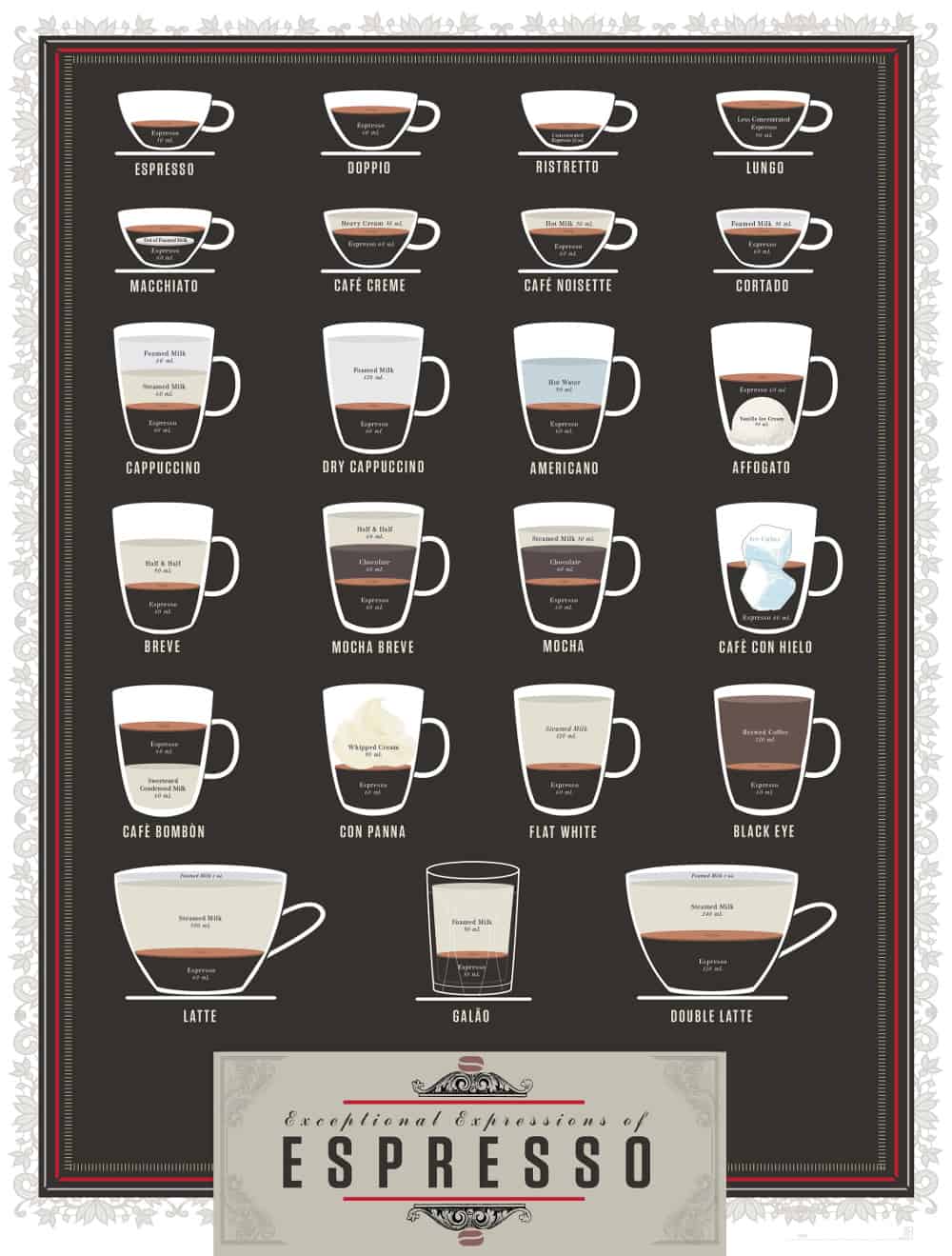
A cafe latte consists of 2 fluid ounces of espresso, 3 ounces of steamed milk, and typically a thin layer of foam on top. It can sometimes be referred to as a "Wet Cappuccino".

For instructions, see How to make a Latte.

Latte vs. Cappuccino vs. Macchiato

This differs from a cappuccino which is equal parts espresso and steamed milk and foam, while an Espresso Macchiato which is equal parts espresso and foamed milk, without the steamed milk. Macchiatos are sometimes called "Dry Cappuccinos".

Most commercial coffee shops have turned a Cappuccino into a Macchiato (eg. they leave out the steamed milk portion), and use the "Macchiato" term for flavored drinks.

Espresso Field Guide by OrbitVisual.com
Other "Lattes"

While the most common Latte is a Caffe Latte, it can be made using something else as a substitute for the espresso. Common alternatives include mate ("maw-teh"), chai or matcha.

There are also a number of alternatives to milk on the market for those that are lactose intolerant or have other dietary needs. Companies such as Pacific Barista have specially formulated almond milk, soy milk and coconut milk alternatives, as well as some more niche ones like rice milk and hemp milk. While normal off-the-shelf products at a grocery store can be used, barista-specific brands have micro-foaming agents and other foaming agents that make it easier to froth and steam.

There are also "specialty" lattes, such as the activated charcoal latte.

Simple Steps Guarantee Creamy, Velvety Milk and Smooth, High-Quality Foam

When you steam milk for a latte and other espresso drinks, you are injecting air into the milk to create a creamy and velvety milk with a very rich taste. The skilled barista creates a smooth foam without large bubbles so it blends with the espresso drink in a harmony of flavors.

Tips for Perfect Steamed Milk and Foam

  1. Use very cold milk. Take it out of the refrigerator just before you use it and then fill your steaming pitcher about one third full. Do not fill it any fuller because when you steam and aerate the milk properly it will double or even triple in volume.
  2. A good choice of milk is either one percent or two percent milk as this will create better foam than whole milk and a better flavor than low fat milk. While the volume of the milk won't increase is much when you use a milk with more fat, the taste and texture will be richer.
  3. Before you begin steaming/aerating the milk purge the steam wand to get rid of any water that may be inside. Do this by putting a damp towel over the top of the steam wand and then turn on the steam for a few moments.

The Art of Steaming a Latte

  1. Now place the steam wand into the milk in the steaming pitcher and turn on the steam as you aim the steam wand slightly off center so the milk starts to flow in a circular motion.
  2. Keep the steam wand submerged because if you let the tip of the wand come above the surface of the milk it will create large, undesirable bubbles and will also cause splattering
  3. Make sure that the tip of the steam wand stays just beneath the surface of the milk and also that the vortex maintains its circulatory movement.
  4. Listen carefully to the sound the process makes - it should sound like something frying on a grill. When you achieve this sound you know you have for the optimal location for the steam wand to inject air into the milk.
  5. When you find the right location to hold the steam wand in the milk then you should not have to move the steaming pitcher at all because the angle of the pitcher and the pressure coming from the steam wand will maintain the milk's circular motion. The only movement required will be to slowly lower the steaming pitcher as the volume of the milk expands.
  6. With the tip of the steam wand just beneath the surface and the milk rapidly flowing in a circular motion, any large bubbles that form on the surface of the milk should quickly roll back into the milk. Only very small bubbles will remain.

Finding the "Sweet Spot"

Getting your pitcher at the right angle is critical to creating steamed milk - too many bubbles/foam and you'll end up with a cappuccino instead of a latte. Fine tune your steaming skills by paying attention to:

  1. The location of the steam wand that causes a layer of foam to begin forming atop the milk but without creating any large bubbles is known as the "sweet spot."
  2. Once you have found the sweet spot, with the steam wand just kissing the milk's surface and the foam beginning to form, the milk's rolling action should continue and very small and silky bubbles should be create the foam.
  3. Gauge how much foam you will need based upon what type of espresso drink you are preparing. For example, if you are making a cappuccino you will need a fair amount of foam so allow the steam wand to stay near the surface a bit longer than for a latte.

Common Mistakes During Steaming a Latte

Making a latte is a skill best learned through repetition and purposeful practice - each drink is an opportunity to learn something new and correct past mistakes in search of that perfect latte. Here's a few things to avoid:

  • Keep an eye on the quality of the foam and if there are too many large bubbles and too little foam then submerge the steam wand just a bit deeper so more steam pressure is created. Again listen for the high-pitched hissing sound as you continue the aeration process.
  • Check the temperature of the milk during the steaming and aerating process. Once the temperature reaches about 145 degrees Fahrenheit halt the steaming to avoid overheating and scalding the milk. This will cause a off-taste that will taint your espresso drink.
  • If there happens to be a few large bubbles atop the pitcher then you might want to lightly tap the bottom of the steaming pitcher on the counter several times and it will diminish the bubbles.
  • Once you have finished steaming and aerating the milk, clean off the steaming wand using a moist towel. Also turn on the steam for a moment while the towel is placed over the tip of the steaming wand. This will get rid of any milk that remains in or on the tip.

History of the Caffe Latte

As early as 1847 the English term Caffe Latto was used and then the essay Italian Journeys by William Dean Howells in 1867 who used the term caffe latte.

Respected coffee author and reviewer Kenneth Davids has written that the Caffe Latte is basically an American invention and even in Italy it was first found in Italy only in places with predominantly American tourists.

Some say the Caffe Latte was developed for Americans because the traditional Cappuccino was too strong so more steamed milk was added.

A Caffe Latte in the Italian Tradition

The traditional Italian Caffe Latte is usually made in the person's residence using a stovetop Moka Pot (Stovetop espresso maker). Unlike the American version, the milk is not steamed and frothed, but only heated. The hot milk is placed in a cup and the then the concentrated coffee from the Moka pot is poured into the milk.

Barista Espresso Drink Tips - Brew the Perfect Latte

Flavored Caffe Lattes

While the term Caffe Latte simply means "Coffee with Milk," and is usually made with coffee and steamed milk, many people like to add sweet syrups in a variety of flavors. Some popular Caffe Latte flavors include vanilla, caramel and chocolate.

A few teaspoons of the flavored syrup are added to the espresso and stirred in, and then the steamed milk is added. These flavored syrups can be purchased so home baristas can also enjoy flavored lattes.

What is Latte Art?

Latte art has become increasingly common in coffee shops of Europe and America where Baristas add a flourish to the specialty coffee drinks by creating a bit of art atop the steamed and aerated milk to add some aesthetic appeal.

Various shapes and patterns are drawn by the way the steamed milk and foam is poured into the beverage including such designs as trees, hearts and flowers. While this can be done by hand by experienced baristas (and can be fun to try yourself at home), a much simpler solution for amateurs is to use a stencil combined with some sort of cinnamon or chocolate topping.

Espresso and Coffee Brewing Tips

For instructions on making the very best espresso drinks see Espresso Drink Recipes and the How to make a Latte. Also provided are tips on Pulling A Perfect Espresso Shot.

For the history of espresso and coffee see World's Best History of Coffee, and for a complete list of coffee terminology with detailed definitions see the Espresso Coffee Guides Coffee Terms.

Share to:

  • Facebook
  • X
  • Email

Leave a Reply Cancel reply

Your email address will not be published. Required fields are marked *

Recipe Rating


Welcome!

EspressoCoffeeGuide is your comprehensive guide to the top coffee origins and information on coffee beans

More about me

More Modern Sidebar

  • Sample Page
  • Green Coffee Prices
  • Disclosure
  • Exotic Coffee Beans
  • How Much Caffeine in a Cup of Coffee?
  • EspressoCoffeeGuide Advertising Opportunities
  • White Coffee
  • Products
  • Coffee Flour
  • Collections
  • Flavored Coffee Beans
  • Espresso Beans
  • Green Coffee Beans
  • Coffee Beans
  • How much coffee per cup? Measures and Ratios
  • Coffee
  • Coffee Bar Party Ideas
  • Starbucks
  • How Many Ounces In a Shot of Espresso?
  • Is there a legal limit for caffeine content?
  • Cold Brew Coffee Guide
  • Shipping
  • Caffeine FAQ
  • Caffeine Withdrawal Symptoms and Side Effects
  • Theine vs Caffeine in Tea
  • Caffeine and Metabolism
  • Barista Resume for Coffee Shops (2019)
  • Coffee Plant Facts and Information
  • The Best Coffee Beans in the World
  • Contact
  • Too Much Caffeine? Antidotes and Remedies
  • Coffee Prices
  • About
  • Subscribe
  • Top 10 Most Expensive Coffee Beans in the World
  • What is a Latte?
  • What is a Macchiato?
  • 3 Parts of an Espresso Shot - Body, Heart, Crema
  • What is Quality Coffee?
  • How to Pull a Ristretto Espresso Shot
  • Privacy Policy
  • What is a Moka Pot (Stove Top)?
  • Single Origin Coffee Beans
  • African Coffees
  • Angola Coffee Beans
  • Benin Coffee Beans
  • Burundi Coffee Beans
  • Cameroon Coffee
  • Central African Republic Coffee
  • Equatorial Guinea Coffee Beans
  • Congo Coffee Beans
  • Ethiopian Coffee Beans
  • Ethiopian Djimmah Coffee Beans
  • Ethiopian Harrar Coffee Beans
  • Ethiopian Harrar Longberry Coffee Beans
  • Ethiopian Harrar Mocha Coffee Beans
  • Ethiopian Limu Coffee Beans
  • Ethiopian Sidamo Coffee Beans
  • Ethiopian Yirgacheffe Coffee Beans
  • Ethiopian Coffee Ceremony
  • Gabon Coffee
  • Ghana Coffee
  • Ivory Coast Coffee - Cote D'Ivoire Coffee
  • Kenya Coffee Beans
  • Kenya AA Coffee Beans
  • Kenya Coffee Grading
  • Liberian Coffee - Coffees of Liberia
  • Madagascar Coffee Beans
  • Malawai Coffee Beans
  • Nigerian Coffee Beans
  • Rwanda Coffee Beans
  • Sierra Leone Coffee Beans
  • Tanzania Coffee Beans
  • Tanzania Peaberry Coffee Beans
  • Tanzania Kilimanjaro Coffee
  • Togo Coffee Beans
  • Uganda Coffee Beans
  • Zaire Coffee Beans
  • Yemen Coffee Beans
  • Yemen Mocha Coffee Beans
  • Zambia Coffee Beans
  • Zimbabwe Coffee Beans
  • Indonesian Coffees
  • Australian Coffee Beans
  • Bali Coffee Beans
  • Cambodian Coffee
  • Borneo Coffee Beans
  • Coffee Beans from China
  • Yunnan Coffee Beans
  • Kopi Luwak / Civet Coffee Beans
  • Association of Indonesian Coffee Luwak Farmers
  • Simulated Civet Coffee Beans
  • Brewing Civet Coffee Beans
  • Civet Coffee From Tree to Cup
  • What is Kopi Luwak / Civet Coffee? (part 2)
  • Civet Coffees Around the World
  • Beware of Fake Civet Coffee
  • Jacu Bird Coffee Beans
  • Hawaii Coffee Beans
  • Hawaiian Kona Coffee Beans
  • Hawaii Kona Blend Coffee Beans
  • Oahu Coffee Beans
  • Maui Coffee Beans
  • Maui Coffee at Kaanapali Estates
  • Molokai Coffee Beans
  • Kauai Coffee Beans
  • Hawaii Coffee Grading
  • Hawaii Kona Coffee History
  • Coffee Beans from India
  • India Mysore Coffee Beans
  • Indonesian Coffee Beans
  • Arabica Java Coffee Beans
  • Old Java Coffee Beans
  • Old Brown Java Coffee Beans
  • Old Government Coffee Beans
  • Sulawesi Coffee Beans
  • Sulawesi Toraja Coffee Beans
  • Sumatra Coffee Beans
  • Sumatra Lintong Coffee Beans
  • Sumatra Mandheling Coffee Beans
  • Sumatra Ankola Coffee Beans
  • Kopi Luwak
  • Laos Coffee - Laotian Coffee Beans
  • Malaysian Coffee Beans
  • Mocha Java Coffee Beans
  • Myanmar Coffee - Burma Coffee Beans
  • Nepal Coffee - Nepalese Coffee Beans
  • Himalayan Coffee Beans
  • New Caledonia Coffee
  • Papua New Guinea Coffee Beans (PNG)
  • New Guinea Sigri Coffee Beans
  • Philippine Coffee Beans
  • Sri Lanka Coffee Beans
  • Thai Coffee - Thailand Coffee
  • Timor Coffee Beans
  • Vanuatu Coffee Beans
  • Vietnam Coffee Beans
  • South American Coffees
  • Chilean Coffee Beans
  • Belize Coffee Beans
  • Bolivian Coffee Beans
  • Brazilian Coffee Beans
  • Brazil Cerrado Coffee Beans
  • Cuban Coffee Beans
  • Colombian Coffee Beans
  • Colombian Medellin Supremo Coffee Beans
  • Colombian Excelso and Supremo Coffee Beans
  • Colombian Narino Coffee Beans
  • Costa Rican Coffee Beans
  • Costa Rica Alajuela Coffee Beans
  • Costa Rica Monte Crisol Coffee Beans
  • Costa Rica San Marcos De Tarrazu Coffee Beans
  • Costa Rica Tarrazu Coffee Beans
  • Jamaica Coffee Beans
  • Jamaica Blue Mountain Coffee Beans
  • Dominican Republic Coffee Beans
  • Dominican Republic Bani Coffee Beans
  • Dominican Republic Barahona Coffee Beans
  • Dominican Republic Cibao Altura Coffee Beans
  • Dominican Republic Ocoa Coffee Beans
  • Ecuador Coffee Beans
  • El Salvador Coffee Beans
  • Paraguay Coffee Beans
  • Puerto Rico Coffee
  • Guatemala Coffee Beans
  • Guatemala Antigua
  • Guatemala Coban Coffee Beans
  • Guatemala Huehuetenango Coffee Beans
  • Haiti Coffee Beans
  • Haitian Blue Coffee Beans
  • Honduran Coffee Beans
  • Mexican Coffee Beans
  • Mexican Altura Coatepec Coffee Beans
  • Mexican Capulin Coffee Beans
  • Mexican Chiapas Coffee Beans
  • Mexican Oaxaca Pluma Coffee Beans
  • Mexican Tapachula Coffee Beans
  • Nicaragua Coffee Beans
  • Panama Coffee Beans
  • Panama Geisha Coffee Beans
  • Trinidad and Tobago Coffee Beans
  • Peru Coffee Beans
  • Peru Chanchamayo High Grown Coffee
  • Venezuela Coffee Beans
  • All About Coffee Beans
  • Inspirational Coffee Quotes
  • Calories in a Cup of Coffee
  • DIY Body Coffee Scrub
  • How do you pronounce mate?
  • Why would you put egg shell in coffee?
  • Coffee Plants
  • Typica Coffee Beans
  • Bourbon Coffee Beans
  • Arabica Coffee Beans
  • Robusta Coffee Beans
  • Liberica Coffee Beans
  • Coffee Plant Varietals
  • Selective Breeding
  • Coffee Plant Diseases and Pests
  • Coffee Cherry
  • Peaberry Coffee Beans
  • Harvesting Coffee
  • Coffee Processing Methods
  • What is "Wet Processing" Coffee?
  • What is "Pulped Natural" Coffee Processing?
  • What is "Semi-Washed" Coffee Processing?
  • Grading Coffee
  • Coffee Defects
  • Roasting Green Coffee
  • Light Roast
  • Best Medium Roast Coffees
  • Medium-Dark Roast
  • Best Dark Roast Coffees
  • Home Roasting
  • Coffee Roasters
  • Coffee Packaging
  • How to Make Coffee
  • Best Alcoholic Coffee Cocktail Recipes
  • What is Coffee "Flavor"?
  • What is Coffee "Body"?
  • What is Coffee "Aroma"?
  • What is Coffee "Bitterness"?
  • What is Coffee "Sweetness"?
  • Coffee Cupping - Professional Coffee Tasting
  • Funny Coffee Quotes
  • Coffee Quiz
  • World's Best History of Coffee Timeline
  • Coffee History / Pre-1600
  • Coffee History / 1600-1650
  • Coffee History / 1650-1700
  • Coffee History / 1700-1750
  • Coffee History / 1750-1800
  • Coffee History / 1800-1850
  • Coffee History / 1850-1900
  • Coffee History / 1900-1950
  • Coffee History / 1950-Present
  • Bird Friendly Coffee Beans
  • The Best Coffee Makers (2019)
  • Vacuum Coffee Maker
  • Coffee Percolator
  • How To Clean a Coffee Maker
  • Automatic Drip Coffee Makers
  • Single Serve Coffee Makers
  • Pod Coffee Makers
  • Coffee Pods
  • Keurig K-Cups
  • Best K-Cup Coffees
  • T-Discs (Tassimo Coffee Pods)
  • French Press Coffee
  • Coffee Containers
  • Low Acid Coffee
  • What is Espresso?
  • Espresso Coffee
  • Espresso Beans
  • How to Make Espresso
  • Espresso Blonding, Channeling, Tiger Striping
  • Grinding Coffee For Espresso
  • Espresso Tampers
  • Espresso Technical Specifications
  • Espresso Crema
  • How to Pull an Espresso Shot
  • Steaming and Frothing Milk
  • Espresso Drink Recipes
  • How To Make Irish Coffee (Cafe Irlandes)
  • How to Make a Vietnamese Coconut Egg Coffee
  • How to make a Black Russian (Recipe)
  • How to make an Espresso Daiquiri Cocktail (Recipe)
  • How to make a Flying Frenchman Cocktail (Recipe)
  • How to make a Carajillo Spanish Coffee (Recipe)
  • Iced Coffee Recipes
  • How to Make a Cafecito / Cuban Coffee
  • Submit Your Coffee Recipe
  • How to Make a Cafe Bombon (Recipe)
  • How to Make a Cafe Con Leche (Recipe)
  • How to Make Espresso con Panna (Recipe)
  • Activated Charcoal Latte Recipe
  • How to Make an Espresso Float
  • Italian Soda
  • Turkish Coffee Recipe
  • Best Espresso Machines (2019)
  • The Best Saeco Home Espresso Machine (2018)
  • Pod Espresso Machines
  • ESE Pods - Easy Serving Espresso Pods
  • Home Espresso Machines
  • Prosumer Espresso Machines
  • Commercial Espresso Machines
  • Piston-Driven Espresso Machines
  • Pump-Driven Espresso Machines
  • Steam-Driven Espresso Machines
  • Air-Pump Espresso Machines
  • Automatic Espresso Machines
  • Super-Automatic Espresso Machines
  • Shade-Grown Coffee Beans
  • Coffee Grinders
  • Baratza Coffee Grinder
  • Burr Coffee Grinders
  • Conical Burr Grinders
  • Blade Coffee Grinders
  • Organic Coffee Beans
  • Instant Coffee
  • Freeze-Dried Coffee
  • History of Instant Coffee
  • Decaffeinated Coffee Beans
  • Direct Contact Method of Decaffeination
  • Indirect Contact Method of Decaffeination
  • Carbon Dioxide Method (CO2) of Decaffeination
  • Swiss Water Process of Decaffeination
  • Fair Trade Coffee Beans
  • Coffee Terms
  • Strictly High Grown Coffee
  • Coffee Terms - A
  • Coffee Terms - B
  • Coffee Terms - C (Part 1)
  • Coffee Terms - C (Part 2)
  • Coffee Terms - D
  • Coffee Terms - E
  • Coffee Terms - F
  • Coffee Terms - G
  • Coffee Terms - H
  • Coffee Terms - I
  • Coffee Terms - J
  • Coffee Terms - K
  • Coffee Terms - L
  • Coffee Terms - M
  • Coffee Terms - N
  • Coffee Terms - O
  • Coffee Terms - P
  • Coffee Terms - Q
  • Coffee Terms - R
  • Coffee Terms - S
  • Coffee Terms - T
  • Coffee Terms - U
  • Coffee Terms - V
  • Coffee Terms - W
  • Coffee Terms - X
  • Coffee Terms - Y
  • Coffee Terms - Z
  • How to make a Latte
  • Useful Resources
  • Coffee Production Volumes 2008 - 2013
  • Coffee Crop Years
  • Organic and Fair Trade Organizations

Guide to the Top Coffees

  • Kenya Coffee Beans
  • Sulawesi Coffee Beans
  • Yirgacheffe Coffee Beans
  • Sumatra Coffee Beans
  • Harrar Coffee Beans
  • Costa Rican Coffee Beans
  • Brazilian Coffee Beans
  • Mocha Java Coffee Beans
  • Tanzania Coffee Beans
  • Guatemala Coffee Beans
  • Ethiopian Coffee Beans
  • Colombian Coffee Beans
  • Honduran Coffee Beans
  • Hawaiian Kona Coffee Beans
  • Geisha Coffee Beans
  • Espresso Beans
  • Best Coffee Beans

Popular

  • Turmeric Latte
  • Coffee Cake Muffins
  • Dirty Chai Latte
  • a cup of chicory coffee with chicory flowers beside it
    Chicory Coffee

Footer

back to top

ABOUT ESPRESSOCOFFEEGUIDE.COM

Find out more About us and what we're doing.

Information is pulled from a number of locations including official sources ICO, SCA, as well as proprietary third party databases. Beginning circa 2006, we've compiled data and written about coffee and continue to revise and add as new sources come to light. If you have any recommendations or suggested revisions please contact us!

Information on single origins is updated over time and only reflects the data we have at the time of writing on current crops. All product names, logos, and brands are property of their respective owners. EspressoCoffeeGuide.com reserves the right to all its own content.

COLLABORATE WITH US

We're always looking to team up with individuals and companies doing awesome things in the coffee industry. If you'd like to contribute please reach out to us with a proposal!

Contact us

Privacy Policy

Disclosure: We may earn commission at no cost to you from some links on this website. However, the content, opinions and analysis are 100% objective and editorial objectivity is our priority.

Copyright © 2025 EspressoCoffeeGuide