
• Recipes
  • Best Coffees
  • Guide
    • South American Coffees
    • African Coffees
    • Indonesian Coffees
  • Contact
menu icon
go to homepage
  • Recipes
  • Best Coffees
  • Guide
    • South American Coffees
    • African Coffees
    • Indonesian Coffees
  • Contact
subscribe
search icon
Homepage link
  • Recipes
  • Best Coffees
  • Guide
    • South American Coffees
    • African Coffees
    • Indonesian Coffees
  • Contact
×
Home

Low Acid Coffee

Acidity in coffee doesn't refer to the PH level, but is one of the basic taste characteristics along with body, aroma, sweetness, bitterness and aftertaste. Too little acidity can result in a flat or dull coffee.

There are some repercussions for people who have a delicate digestive system, in which high-grade coffee can cause acid reflux or otherwise upset the stomach due to increased concentrations of healthy organic acids. While those with normal digestive systems can handle the wonderful acids (that are beneficial to your health), there is a market for low-acid coffees.

Jump to:
  • Best Low Acid Coffees
  • Best Low Acid Coffee Recipe
  • About Coffee Acidity
  • Best High Acid Coffees

Best Low Acid Coffees

A good starter point for low-acid coffees is by origin. While there is variation in the amount of acidity within a country (which are large and very diverse), it provides a start to narrowing down your choices. Some of the best low-acid coffee in the world come from:

  1. Brazil
  2. Sumatra
  3. Nicaragua

Coffees grown at low altitudes have a tendency to develop less acids during the growing process, and are therefore the least acidic coffees. Dry (also known as "Natural") processing also tends to result in a lower acid coffee.

The tradeoff here is that the coffee will have less of a "kick". Coffees with low acidity are generally looked down upon by coffee snobs, but since coffee is a personal experience, only your own opinion should matter.

Acidity is generally considered a positive for coffee, providing brightness to the flavor and enhancing other qualities. The organic acids in coffee contain powerful anti-oxidant properties that contribute some of the health benefits to coffee, but there's a trade-off for some people.

Roast Level for Lower Acidity

Aside from selecting a low-acid coffee based on origin (and there are variations even within a country), the roast can play a part in lowering the acidity of the coffee. Typically derived from organic acids within the coffee, roasting longer will burn off more of the acids, removing them from the beans and therefore the drink once brewed.

A darker roast will generally have lower acidity than lighter roasts, as the organic acids are burnt off during the roasting process.

The two primary organic chemicals in coffee that are associated with upset stomachs are N-alkanoly-5-hydroxytryptamides and catechols. On the other hand, some compounds such as N-methylpyridinium (NMP) have been shown to help settle stomachs - it's NMPs that have been found at higher levels in darker roasts than lighter roasts.

Cold Brewing's Effect on Low Acidity

Cold brew coffee tends to do very well for those who are sensitive to coffee, due to a lower extraction temperature of the coffee grounds over the course of many hours. Higher temperatures are required to extract some of the acidic compounds found in coffee, and these higher temperatures aren't found when cold brewing.

Broadly speaking, a darker roast also works best for cold brew, which further reduces the acidity.

Finally, adding milk or a milk substitute will help make the drink more palatable to your stomach.

Decaf Coffee is good for Low Acid

The process used to extract caffeine also pulls out many of the other compounds that naturally occur in green coffees. Regardless of how they're decaffeinated - swiss water, CO2, other solvents - they lose more than just caffeine, which reduces the levels of other acids.

While any decaf method will pull out some of the "healthy" compounds, none of them will make coffee unhealthy. A common misconception is that solvents are less healthy than CO2 or swiss water, but they are burnt off at a much lower temperature than coffee is roasted at, leaving no trace of any compounds in the final roasted coffee.

Similarly, chicory is sometimes blended into a coffee to reduce the overall acidity, making it more tolerable for those with an acidity sensitivity.

Low Acid Coffee Brands

Coffee brands (such as Puroast) that advertise that they're low-acid are simply well branded and marketed. There is nothing exclusive or proprietary about their coffees.

Any brand is capable of making low acid coffee, and some coffees are low acid without being marketed as such. If you're looking for a low-acid coffee from a specific brand, we recommend looking for coffee that is

  1. one of the low acid coffees above (brazil, sumatra, nicaragua)
  2. dark roasted

From there, you'll ideally want to cold-brew the coffee. Products like k-cups make this impossible, but you can cold brew in a french press, which is very inexpensive as a second piece of brewing equipment.

Best Low Acid Coffee Recipe

EspressoCoffeeGuide.com
There's a number of different things you can do to make a coffee low-acid. We'll combine all the tips in this post - using a low acid origin, lowest acid roast, and lowest acid brewing method.
5 from 3 votes
Prevent your screen from going dark

Ingredients
  

  • 36 g coffee dark roast, brazilian
  • 360 g water 12 oz, not distilled

Instructions
 

  • Combine 36g (1.2 oz) dark roasted brazilian coffee with 360g (12 oz) room temperature water in a french press or other container
  • Store in fridge for 12-24 hours
  • Remove coffee grounds from water either by straining
  • Serve within 24 hours

Notes

  • Do not use distilled water - the lack of minerals impairs taste
  • You can substitute the Brazilian coffee with Sumatra or Colombian
  • We didn't use a decaf coffee because decaf isn't really coffee, but if you're set on it, you can use a decaf coffee
  • This recipe is designed for a single service (12 oz), but scales up linearly - 100 grams of coffee per 1000 ml of water will make almost 3 servings
  • We recommend a french press here, but you can also use a cheesecloth or other strainer
  • This recipe also makes fantastic coffee ice cubes that don't overpower the drinks you put them in
Print Recipe
Tried this recipe?Let us know how it was!

About Coffee Acidity

Acidity is a basic taste and one of the major coffee taste characteristics along with:

  • body
  • aroma
  • sweetness
  • bitterness
  • aftertaste

These qualities are used by cuppers (professional coffee tasters) to judge coffees and compare the qualities of different coffees. The desirable quality of acidity is due to acids in the coffee combining with sugars and increasing the coffee's overall sweetness while also adding a certain vigor to the coffee.

Without acidity, a coffee will tend to taste dull and lifeless. Acidity is a desirable primary coffee flavor sensation that is perceived as a pleasing sharpness toward the front of the mouth, a numbing sensation on the tip of the tongue, or a dryness at the back of the palate and/or under the edges of the tongue; denotes the quality of a coffee.

A good acidity will lean towards being sweet, crisp and tart - enhancing the other qualities in a coffee. Coffees that are known for their pleasant acidity include the Kenya AA, Ethiopian Yirgacheffe, Costa Rica and Nicaragua.

A bad acidity will taste sour and stringent, sometimes almost chemically.

Roast Level Affect on Acidity

As many of the acidic qualities are imparted by the organic compounds (such as chlorogenic acid) found in coffee, lighter roasts will generally have brighter acidity than darker roasts. This is because the organic chemicals are slowly destroyed during the roasting process, with the sugars caramelizing and the sweetness muting the acidity.

Acidity will generally decrease and become less prominent as a roast gets darker - a light or medium roast will have higher acidity than a dark or espresso roast.

Is espresso less acidic than coffee?

Yes. Roasting a coffee longer results in more decomposing of the healthy chlorogenic acids that give lighter roasts their acidity. This means that an espresso roast will be less acidic than a light or medium roast.
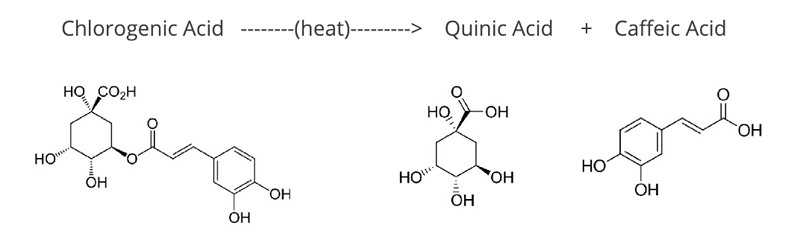
The roasting process breaks down the chlorogenic acids found in coffee beans into roughly equal quantities of caffeic and quinic acids.

These compounds, which are phenolic in nature, contribute to coffee's astringency and lingering aftertaste.

The Chemistry of Organic Acids - CoffeeChemistry.com

What people generally tend to misinterpret as acidic in espresso beans is the presence of more bitter and astringent compounds (which is different than acidic) from the roast level. A good espresso should not be burnt and bitter.

Additionally, the brewing process for espresso (high temperature, high pressure) results in more thorough extraction of the bitter chemicals and compounds in the coffee.

Acidity vs. Bitterness

A coffee's acidity may impart a pleasant tartness, or snap, somewhat like a dry wine, yet it should not be so acidic that it causes bitterness. Acidity is generally perceived as a positive quality in coffee.

Acidity is often described as dry, sharp (e.g., a sharp radiance enhancing the flavor), vibrant, lively, moderate, or dull. A coffee's acidity may have a subtle fruity quality which may be further specified as, for example, citrusy, lemony, or berry-like.

What is Coffee's pH Level?

Coffee does indeed have a pH level, but this is not a useful measure of flavor. It would vary depending on brewing method and roast level, but not significantly.

Most (black) coffees have a pH around 4.5.

A "low acid coffee" (Sumatra) falls around 4.7 and a "high acid coffee" (Kenya) falls around 4.3. While this may not seem like a big difference, the pH scale operates on a logarithm (4.0 is 10x more acidic than 5.0), so a 0.4 difference can actually be substantial.

For comparison, apple juice lands at 3.8 (much more acidic).

Acidity as a flavor descriptor does not refer to the pH level (degree of acidity) of the coffee. It also shouldn't be confused with the character of sourness (an unpleasant, undesirable sharpness or over-fermented bitterness).

This ambiguity is nothing more than a failure of the coffee industry to properly name its measures.

A high acidity is described as bright while a low acid coffee may be described as smooth, but if it is too low it will be considered unexciting and boring. A total lack of acidity may also result in a "flat" coffee.

Black coffee generally lands around a pH of 4.5 (acidic, not basic) and milk has a pH of 6.5 (slightly more neutral). This means that adding milk to coffee makes it slightly less acidic by way of dilution. [source]

Best High Acid Coffees

High-altitude premium coffees known for their bright and vibrant acidity include:

  • Guatemalan Coffees
  • Kenyan Coffees
  • Costa Rican Coffees

Mexican coffees tend to have a bright, clear acidity, in contrast to the overwhelming acidity typically present in Yemen Mocha coffees, which may even taste distinctively winey and sweet with a winey aftertaste. Coffees grown at higher altitudes tend to have a higher acidity, due to the slower growth at those elevations, which allows the beans to develop more of their chemical compounds (chlorogenic acids) that contribute to flavor.

Share to:

  • Facebook
  • X
  • Email

Comments

  1. giallo says

    June 22, 2022 at 6:57 pm

    I don't like any kind of acidity in coffee. do you like lemon in your coffee? I tried so many "bright" and "exciting" coffee. they are sour. terrible. undrinkable.
    Sorry, I'm Italian, I like boring espresso, I cannot drink coffee outside of Italy, and that is funny because every barista in the world uses (badly) Italian espresso coffee machines.
    what is wrong with you..? or us...? who knows?

    Reply
    • EspressoCoffeeGuide.com says

      June 30, 2022 at 4:40 am

      Agreed - coffee is 100% personal preference.

      As noted above, the acidity (pH) of something like lemons is unrelated to the acidity flavour factor of coffee. This is a confusing, but important, distinction.

      Reply
  2. Tami Sedanos says

    June 16, 2021 at 4:50 am

    factory of plant extract

    Reply
  3. Carlene says

    September 05, 2019 at 10:05 am

    This post is so very helpful to me! Thank you so much. I have ulcer issues and this will guide me through the process of choosing coffee wisely.

    Reply
  4. George says

    April 28, 2017 at 3:19 pm

    The new trend from San Francisco is light roasting. It gives the coffee a green citric astringent note. NO carmelization, eathy tones like Trad espresso. Hopefully this sad fad will pass soon.

    Reply

Leave a Reply Cancel reply

Your email address will not be published. Required fields are marked *

Recipe Rating


Welcome!

EspressoCoffeeGuide is your comprehensive guide to the top coffee origins and information on coffee beans

More about me

More Modern Sidebar

  • Sample Page
  • Green Coffee Prices
  • Disclosure
  • Exotic Coffee Beans
  • How Much Caffeine in a Cup of Coffee?
  • EspressoCoffeeGuide Advertising Opportunities
  • White Coffee
  • Products
  • Coffee Flour
  • Collections
  • Flavored Coffee Beans
  • Espresso Beans
  • Green Coffee Beans
  • Coffee Beans
  • How much coffee per cup? Measures and Ratios
  • Coffee
  • Coffee Bar Party Ideas
  • Starbucks
  • How Many Ounces In a Shot of Espresso?
  • Is there a legal limit for caffeine content?
  • Cold Brew Coffee Guide
  • Shipping
  • Caffeine FAQ
  • Caffeine Withdrawal Symptoms and Side Effects
  • Theine vs Caffeine in Tea
  • Caffeine and Metabolism
  • Barista Resume for Coffee Shops (2019)
  • Coffee Plant Facts and Information
  • The Best Coffee Beans in the World
  • Contact
  • Too Much Caffeine? Antidotes and Remedies
  • Coffee Prices
  • About
  • Subscribe
  • Top 10 Most Expensive Coffee Beans in the World
  • What is a Latte?
  • What is a Macchiato?
  • 3 Parts of an Espresso Shot - Body, Heart, Crema
  • What is Quality Coffee?
  • How to Pull a Ristretto Espresso Shot
  • Privacy Policy
  • What is a Moka Pot (Stove Top)?
  • Single Origin Coffee Beans
  • African Coffees
  • Angola Coffee Beans
  • Benin Coffee Beans
  • Burundi Coffee Beans
  • Cameroon Coffee
  • Central African Republic Coffee
  • Equatorial Guinea Coffee Beans
  • Congo Coffee Beans
  • Ethiopian Coffee Beans
  • Ethiopian Djimmah Coffee Beans
  • Ethiopian Harrar Coffee Beans
  • Ethiopian Harrar Longberry Coffee Beans
  • Ethiopian Harrar Mocha Coffee Beans
  • Ethiopian Limu Coffee Beans
  • Ethiopian Sidamo Coffee Beans
  • Ethiopian Yirgacheffe Coffee Beans
  • Ethiopian Coffee Ceremony
  • Gabon Coffee
  • Ghana Coffee
  • Ivory Coast Coffee - Cote D'Ivoire Coffee
  • Kenya Coffee Beans
  • Kenya AA Coffee Beans
  • Kenya Coffee Grading
  • Liberian Coffee - Coffees of Liberia
  • Madagascar Coffee Beans
  • Malawai Coffee Beans
  • Nigerian Coffee Beans
  • Rwanda Coffee Beans
  • Sierra Leone Coffee Beans
  • Tanzania Coffee Beans
  • Tanzania Peaberry Coffee Beans
  • Tanzania Kilimanjaro Coffee
  • Togo Coffee Beans
  • Uganda Coffee Beans
  • Zaire Coffee Beans
  • Yemen Coffee Beans
  • Yemen Mocha Coffee Beans
  • Zambia Coffee Beans
  • Zimbabwe Coffee Beans
  • Indonesian Coffees
  • Australian Coffee Beans
  • Bali Coffee Beans
  • Cambodian Coffee
  • Borneo Coffee Beans
  • Coffee Beans from China
  • Yunnan Coffee Beans
  • Kopi Luwak / Civet Coffee Beans
  • Association of Indonesian Coffee Luwak Farmers
  • Simulated Civet Coffee Beans
  • Brewing Civet Coffee Beans
  • Civet Coffee From Tree to Cup
  • What is Kopi Luwak / Civet Coffee? (part 2)
  • Civet Coffees Around the World
  • Beware of Fake Civet Coffee
  • Jacu Bird Coffee Beans
  • Hawaii Coffee Beans
  • Hawaiian Kona Coffee Beans
  • Hawaii Kona Blend Coffee Beans
  • Oahu Coffee Beans
  • Maui Coffee Beans
  • Maui Coffee at Kaanapali Estates
  • Molokai Coffee Beans
  • Kauai Coffee Beans
  • Hawaii Coffee Grading
  • Hawaii Kona Coffee History
  • Coffee Beans from India
  • India Mysore Coffee Beans
  • Indonesian Coffee Beans
  • Arabica Java Coffee Beans
  • Old Java Coffee Beans
  • Old Brown Java Coffee Beans
  • Old Government Coffee Beans
  • Sulawesi Coffee Beans
  • Sulawesi Toraja Coffee Beans
  • Sumatra Coffee Beans
  • Sumatra Lintong Coffee Beans
  • Sumatra Mandheling Coffee Beans
  • Sumatra Ankola Coffee Beans
  • Kopi Luwak
  • Laos Coffee - Laotian Coffee Beans
  • Malaysian Coffee Beans
  • Mocha Java Coffee Beans
  • Myanmar Coffee - Burma Coffee Beans
  • Nepal Coffee - Nepalese Coffee Beans
  • Himalayan Coffee Beans
  • New Caledonia Coffee
  • Papua New Guinea Coffee Beans (PNG)
  • New Guinea Sigri Coffee Beans
  • Philippine Coffee Beans
  • Sri Lanka Coffee Beans
  • Thai Coffee - Thailand Coffee
  • Timor Coffee Beans
  • Vanuatu Coffee Beans
  • Vietnam Coffee Beans
  • South American Coffees
  • Chilean Coffee Beans
  • Belize Coffee Beans
  • Bolivian Coffee Beans
  • Brazilian Coffee Beans
  • Brazil Cerrado Coffee Beans
  • Cuban Coffee Beans
  • Colombian Coffee Beans
  • Colombian Medellin Supremo Coffee Beans
  • Colombian Excelso and Supremo Coffee Beans
  • Colombian Narino Coffee Beans
  • Costa Rican Coffee Beans
  • Costa Rica Alajuela Coffee Beans
  • Costa Rica Monte Crisol Coffee Beans
  • Costa Rica San Marcos De Tarrazu Coffee Beans
  • Costa Rica Tarrazu Coffee Beans
  • Jamaica Coffee Beans
  • Jamaica Blue Mountain Coffee Beans
  • Dominican Republic Coffee Beans
  • Dominican Republic Bani Coffee Beans
  • Dominican Republic Barahona Coffee Beans
  • Dominican Republic Cibao Altura Coffee Beans
  • Dominican Republic Ocoa Coffee Beans
  • Ecuador Coffee Beans
  • El Salvador Coffee Beans
  • Paraguay Coffee Beans
  • Puerto Rico Coffee
  • Guatemala Coffee Beans
  • Guatemala Antigua
  • Guatemala Coban Coffee Beans
  • Guatemala Huehuetenango Coffee Beans
  • Haiti Coffee Beans
  • Haitian Blue Coffee Beans
  • Honduran Coffee Beans
  • Mexican Coffee Beans
  • Mexican Altura Coatepec Coffee Beans
  • Mexican Capulin Coffee Beans
  • Mexican Chiapas Coffee Beans
  • Mexican Oaxaca Pluma Coffee Beans
  • Mexican Tapachula Coffee Beans
  • Nicaragua Coffee Beans
  • Panama Coffee Beans
  • Panama Geisha Coffee Beans
  • Trinidad and Tobago Coffee Beans
  • Peru Coffee Beans
  • Peru Chanchamayo High Grown Coffee
  • Venezuela Coffee Beans
  • All About Coffee Beans
  • Inspirational Coffee Quotes
  • Calories in a Cup of Coffee
  • DIY Body Coffee Scrub
  • How do you pronounce mate?
  • Why would you put egg shell in coffee?
  • Coffee Plants
  • Typica Coffee Beans
  • Bourbon Coffee Beans
  • Arabica Coffee Beans
  • Robusta Coffee Beans
  • Liberica Coffee Beans
  • Coffee Plant Varietals
  • Selective Breeding
  • Coffee Plant Diseases and Pests
  • Coffee Cherry
  • Peaberry Coffee Beans
  • Harvesting Coffee
  • Coffee Processing Methods
  • What is "Wet Processing" Coffee?
  • What is "Pulped Natural" Coffee Processing?
  • What is "Semi-Washed" Coffee Processing?
  • Grading Coffee
  • Coffee Defects
  • Roasting Green Coffee
  • Light Roast
  • Best Medium Roast Coffees
  • Medium-Dark Roast
  • Best Dark Roast Coffees
  • Home Roasting
  • Coffee Roasters
  • Coffee Packaging
  • How to Make Coffee
  • Best Alcoholic Coffee Cocktail Recipes
  • What is Coffee "Flavor"?
  • What is Coffee "Body"?
  • What is Coffee "Aroma"?
  • What is Coffee "Bitterness"?
  • What is Coffee "Sweetness"?
  • Coffee Cupping - Professional Coffee Tasting
  • Funny Coffee Quotes
  • Coffee Quiz
  • World's Best History of Coffee Timeline
  • Coffee History / Pre-1600
  • Coffee History / 1600-1650
  • Coffee History / 1650-1700
  • Coffee History / 1700-1750
  • Coffee History / 1750-1800
  • Coffee History / 1800-1850
  • Coffee History / 1850-1900
  • Coffee History / 1900-1950
  • Coffee History / 1950-Present
  • Bird Friendly Coffee Beans
  • The Best Coffee Makers (2019)
  • Vacuum Coffee Maker
  • Coffee Percolator
  • How To Clean a Coffee Maker
  • Automatic Drip Coffee Makers
  • Single Serve Coffee Makers
  • Pod Coffee Makers
  • Coffee Pods
  • Keurig K-Cups
  • Best K-Cup Coffees
  • T-Discs (Tassimo Coffee Pods)
  • French Press Coffee
  • Coffee Containers
  • Low Acid Coffee
  • What is Espresso?
  • Espresso Coffee
  • Espresso Beans
  • How to Make Espresso
  • Espresso Blonding, Channeling, Tiger Striping
  • Grinding Coffee For Espresso
  • Espresso Tampers
  • Espresso Technical Specifications
  • Espresso Crema
  • How to Pull an Espresso Shot
  • Steaming and Frothing Milk
  • Espresso Drink Recipes
  • How To Make Irish Coffee (Cafe Irlandes)
  • How to Make a Vietnamese Coconut Egg Coffee
  • How to make a Black Russian (Recipe)
  • How to make an Espresso Daiquiri Cocktail (Recipe)
  • How to make a Flying Frenchman Cocktail (Recipe)
  • How to make a Carajillo Spanish Coffee (Recipe)
  • Iced Coffee Recipes
  • How to Make a Cafecito / Cuban Coffee
  • Submit Your Coffee Recipe
  • How to Make a Cafe Bombon (Recipe)
  • How to Make a Cafe Con Leche (Recipe)
  • How to Make Espresso con Panna (Recipe)
  • Activated Charcoal Latte Recipe
  • How to Make an Espresso Float
  • Italian Soda
  • Turkish Coffee Recipe
  • Best Espresso Machines (2019)
  • The Best Saeco Home Espresso Machine (2018)
  • Pod Espresso Machines
  • ESE Pods - Easy Serving Espresso Pods
  • Home Espresso Machines
  • Prosumer Espresso Machines
  • Commercial Espresso Machines
  • Piston-Driven Espresso Machines
  • Pump-Driven Espresso Machines
  • Steam-Driven Espresso Machines
  • Air-Pump Espresso Machines
  • Automatic Espresso Machines
  • Super-Automatic Espresso Machines
  • Shade-Grown Coffee Beans
  • Coffee Grinders
  • Baratza Coffee Grinder
  • Burr Coffee Grinders
  • Conical Burr Grinders
  • Blade Coffee Grinders
  • Organic Coffee Beans
  • Instant Coffee
  • Freeze-Dried Coffee
  • History of Instant Coffee
  • Decaffeinated Coffee Beans
  • Direct Contact Method of Decaffeination
  • Indirect Contact Method of Decaffeination
  • Carbon Dioxide Method (CO2) of Decaffeination
  • Swiss Water Process of Decaffeination
  • Fair Trade Coffee Beans
  • Coffee Terms
  • Strictly High Grown Coffee
  • Coffee Terms - A
  • Coffee Terms - B
  • Coffee Terms - C (Part 1)
  • Coffee Terms - C (Part 2)
  • Coffee Terms - D
  • Coffee Terms - E
  • Coffee Terms - F
  • Coffee Terms - G
  • Coffee Terms - H
  • Coffee Terms - I
  • Coffee Terms - J
  • Coffee Terms - K
  • Coffee Terms - L
  • Coffee Terms - M
  • Coffee Terms - N
  • Coffee Terms - O
  • Coffee Terms - P
  • Coffee Terms - Q
  • Coffee Terms - R
  • Coffee Terms - S
  • Coffee Terms - T
  • Coffee Terms - U
  • Coffee Terms - V
  • Coffee Terms - W
  • Coffee Terms - X
  • Coffee Terms - Y
  • Coffee Terms - Z
  • How to make a Latte
  • Useful Resources
  • Coffee Production Volumes 2008 - 2013
  • Coffee Crop Years
  • Organic and Fair Trade Organizations

Guide to the Top Coffees

  • Kenya Coffee Beans
  • Sulawesi Coffee Beans
  • Yirgacheffe Coffee Beans
  • Sumatra Coffee Beans
  • Harrar Coffee Beans
  • Costa Rican Coffee Beans
  • Brazilian Coffee Beans
  • Mocha Java Coffee Beans
  • Tanzania Coffee Beans
  • Guatemala Coffee Beans
  • Ethiopian Coffee Beans
  • Colombian Coffee Beans
  • Honduran Coffee Beans
  • Hawaiian Kona Coffee Beans
  • Geisha Coffee Beans
  • Espresso Beans
  • Best Coffee Beans

Popular

  • Turmeric Latte
  • Coffee Cake Muffins
  • Dirty Chai Latte
  • a cup of chicory coffee with chicory flowers beside it
    Chicory Coffee

Footer

back to top

ABOUT ESPRESSOCOFFEEGUIDE.COM

Find out more About us and what we're doing.

Information is pulled from a number of locations including official sources ICO, SCA, as well as proprietary third party databases. Beginning circa 2006, we've compiled data and written about coffee and continue to revise and add as new sources come to light. If you have any recommendations or suggested revisions please contact us!

Information on single origins is updated over time and only reflects the data we have at the time of writing on current crops. All product names, logos, and brands are property of their respective owners. EspressoCoffeeGuide.com reserves the right to all its own content.

COLLABORATE WITH US

We're always looking to team up with individuals and companies doing awesome things in the coffee industry. If you'd like to contribute please reach out to us with a proposal!

Contact us

Privacy Policy

Disclosure: We may earn commission at no cost to you from some links on this website. However, the content, opinions and analysis are 100% objective and editorial objectivity is our priority.

Copyright © 2025 EspressoCoffeeGuide

Rate This Recipe

Your vote:


A rating is required
A name is required
An email is required