
Known for its consistently rich flavor along with a deep, wine-like acidity and pleasant aroma, Kenyan coffee beans have distinctly bright taste with complex tones of fruit and berry.
- Region: Kenya
- Growing Altitude: 1,700 - 1,800 meters
- Variety: Arabica
- Harvest Period: November - December
- Milling Process: Fully Washed, Sun Dried on Raised Beds
- Aroma: Fresh, Floral
- Flavour: Bergamot, Berries, Lemongrass
- Body: Rich, Heavy
- Acidity: Bright
However, Kenyan coffees have a huge range of flavors and nuances depending on the region, varietal and processing methods used. It's a huge country with a wide variety of cultures and customs and has a lot to offer to those who want to dive into separate regions. The best Kenyan coffees can have a full spectrum of flavors to those with a well developed palate.
Jump to:
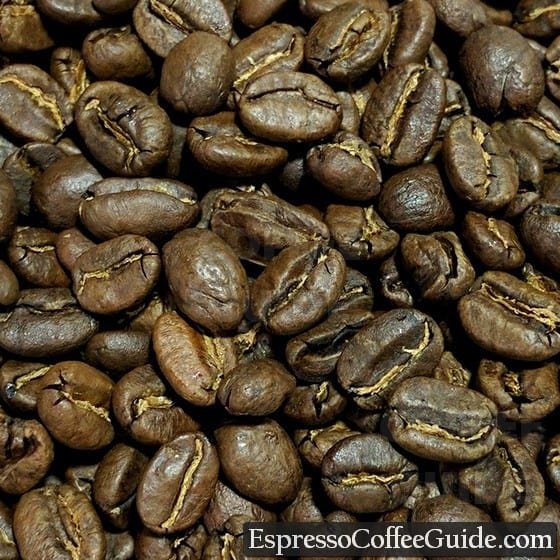
Kenyan coffees are wet-processed (washed) green coffees-bold and with a body that is usually full or medium.
It's not only coffee that Kenya grows however - tea is actually more popular locally, and the coffee plantations can be erratic and dispersed between much larger groves of avocado trees and nut trees.
Coffee characteristics
Known for their potent sweetness and powerful character, Kenyan coffee tasting notes indicate it has a resonant cup presence, exhibiting intense flavors with a distinct winey richness and dry, winey aftertaste similar to Ethiopian Harrar yet with more of a full-bodied richness than Ethiopian coffees.
Best Kenyan Coffees
A good Kenya coffee is vibrant yet clean and crisp, not subtle or delicate, and typically very well-balanced. Notes of lemony citrus may be present, even pepper, along with tones of blackberry. The aftertaste of a Kenya coffee may be quite dry with a lemony zest to it, or perhaps winey.
The best Kenyan coffees will be those that are fresh roasted by local coffee roasters, who work with brokers as well as the farmers directly within Kenya. Having transparency through the supply chain helps roasters communicate feedback to the farmer, who can make adjustments to the growing and processing. Likewise, farmers are able to notify roasters about unexpected changes and developments in the coffees, so that they can make adjustments to the roasting process.
Brands
Coffees from Kenya are frequently sold by brands like Starbucks, or on Amazon, which have been roasted weeks or months prior to being sold. This dulls the flavor of the coffee and can leave people wondering why it's so highly rated. Coffee flavor begins to degrade within weeks of being roasted - days if it is already ground. While a 1-way valve bag helps to slow this process, typically anything with a "best before" date instead of a "roasted on" date is old.
You always want to find a supplier who offers fresh roasted coffee - ideally to order.
Starbucks Kenya AA
The Kenyan Karatina AA was briefly available under the Starbucks reserve program in August 2015.
Starbucks Kenya Kangunu
This one was noted as having flavors including lemon, dark chocolate and black currant.
Tasting Notes
At high elevations on the plateaus of Kenya some of the world's finest premium gourmet coffees are cultivated. With a full body, pleasant acidity, rich flavor and fragrant aroma infused with floral tones, Kenya coffee is known as the "Connoisseurs Cup." Pause to appreciate the sublime, even intoxicating black currant undertones in the flavor and aroma. One reason a mug of Kenya coffee is known as one of the five best coffees in the world is that they have very distinctive flavors.
Also enjoyable is the winey aftertaste which exhibits notes of berry and citrus. Kenyan coffee is typically wet-processed and is known for its powerful character and potent sweetness.
Not subtle or delicate, Kenyan coffee is crisp and vibrant, often compared to a fine Ethiopian Harrar but with a fuller body and more overall richness in the flavor than Ethiopian coffees.
The distinct flavors can vary widely between regions, with each county producing unique twists on Kenya's highly rated beans. Most coffee purchased from the markets will be high quality but difficult (if not impossible) to distinguish the specific region.
The highest rated Kenya coffees are graded Kenya AA which are the biggest beans, said to have more aromatic oils. (See Kenya Coffee Grading.)
Coffee growing
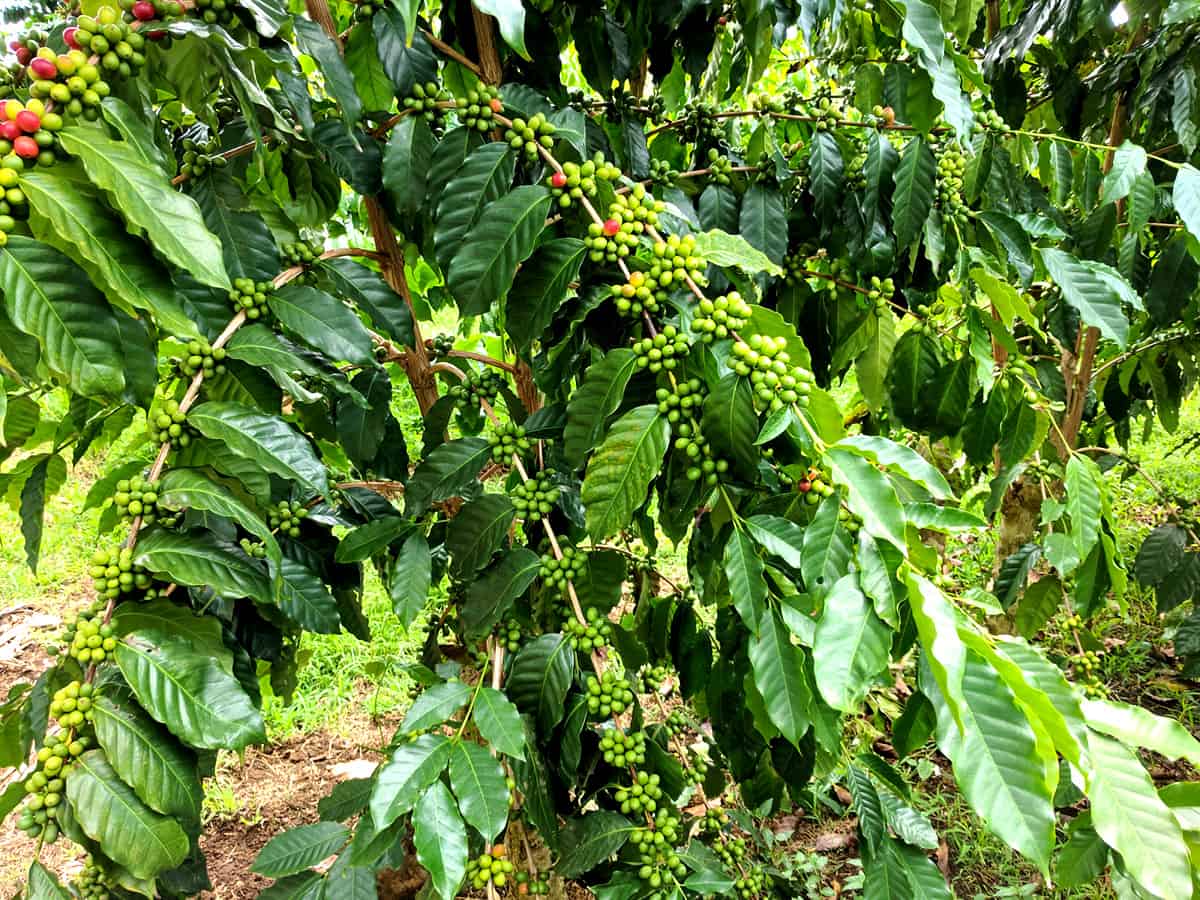
Most of Kenya's green coffees are grown at elevations ranging from 1,400 meters to 2,000 meters above sea level in the volcanic soils on the high plateaus surrounding the snow-capped Mt. Kenya and the foothills of the Aberdare Range.
This elevation qualifies it for Strictly High Grown (SHG) / Strictly Hard Bean (SHB) status. The nature of the high altitude means that Kenyan coffees grow slowly, allowing ample time to develop and providing lots of nutrients to the coffee bean.
The area that spans from 17,000-foot Mt. Kenya south toward the capital of Nairobi is a major coffee growing region, while a smaller growing region is found near the border with Uganda on the hills of Mt. Elgon.
Kenya coffee growing regions include Ruiri, Thika, Kirinyaga, Mt. Kenya West, Nyeri, Kiambu, and Muranga. It's possible to distinguish the coffees from each region if sourced directly - with factors like morning sun vs. evening sun affecting how the flavors and chemicals within the coffee cherry develop over time.
These prime coffee-growing areas include a wide range of native forest ecosystems that support a variety of wildlife.
The coffee industry of Kenya involves many small farms and cooperatives as well as larger estates. In all about six million Kenyans are involved in the country's coffee industry, with most farms consisting of 50-500 trees.
This pales in comparison to some South American countries where a small farm can be 5,000-10,000 trees spread over 1-2 hectares.
Kenya also has a cooperative system of milling the coffee as well as marketing, and auctions are held each Tuesday during the harvest season creating a situation of price wars over the finest Kenya coffees. This market system in Kenya is decades old, running back generations.
The efficiency of it means that most farmers simply sell their coffee - of all qualities - by dropping it off at large buyers or processing stations that sell them sorted but essential indistinguishably from each other, which makes specific lots and microlots very difficult.
Peak season involves cupping upwards of 150 cups daily for buyers, traders and exporters, in an effort to appropriately price the coffees they're buying.
The size and complexity of the Kenyan coffee market hinders the ability of coffee companies to source directly, in an ethical way. Dealing directly with farmers or co-ops to form partnerships and get a consistent output that's traceable is the ideal way to buy green coffees, but requires lots of manhours on the ground, and isn't feasible for most coffee companies.
Varietals
Kenya's red-orange, loamy volcanic soils and the region's moderate climate as well as the ideal equatorial sunlight and well-chosen and Kenya coffee plant varietals
- SL 28
- SL 34
- K7
- Ruiru 11
- Batian
- all distinct to East Africa, as well as Blue Mountain. These varietals allow Kenya to be perhaps the planet's most consistent producer of world-class premium gourmet coffees.
The commercial coffee cultivars produced by Kenya's Coffee Research Foundation include: Ruiri 11, which grows well at all elevations and is resistant to coffee berry disease as well as coffee leaf rust; SL34, which grows well at higher elevations with ample rainfall; SL28, which grows well at high to medium elevations where coffee leaf rust is not a significant problem; and Kent, which grows well at lower elevation areas that are also vulnerable to coffee leaf rust.
The varietal African K7 is a French Mission Bourbon varietal (Coffea arabica var. bourbon) grown in Muhroni, Kenya at the Legetet Estate. It was chosen for cultivation based upon cupping trials. Robusta coffee (Coffea canephora var. robusta) grows in humid, lower elevation areas in Western Kenya.
Harvesting
Kenya's coffee crops in general flower after the rains commence-this occurs in March and April, with the coffee cherry (fruit) ripening from May to July, and then again in September and October, with most of Kenya's coffee cherry coming to ripeness from October to December.
Acidic soils provide optimal growing conditions on the upper elevation high plateau regions surrounding Mt. Kenya including the Aberdare Range, Nyanza, Kisii, Bungoma, Kericho, and Nakuru. The botanical Arabica varietals that are grown in these areas were first introduced from Ethiopia.
Processing
Bulk mechanical and electronic grading-by weight, size, shape, and color-takes place after milling and helps to isolate the best coffee beans while also removing defective beans that may add an off-taste to an otherwise premium gourmet coffees.
According the class system devised by the Coffee Board of Kenya, the worst coffee beans are classified as a one and the best are a ten. A bean may be rated as an AA according to its size, though only a four or five on the class system, which would mean that it wasn't the highest quality coffee bean.
Of all of the premium gourmet coffees in the world-and there are relatively few at the top-Kenya coffee is perhaps the most consistently high quality coffee bean that is also consistently available.
Green Coffee Beans
As some of the world's finest gourmet coffees, Kenyan coffees are carefully graded after harvest for sale on the wholesale market. The coffee beans are separated (sorted) and rated by bean size as well as shape, color, and density, with the general assumption being that bigger coffee beans are higher in quality.
A general rules with Kenya coffee beans is that bigger beans have more essential oils that enhance the tastes and aromas. The largest and best coffee beans from Kenya are graded Kenya AA.
Other factors are also important in determining the beans' quality, and cuppers (professional coffee tasters) debate whether bean size necessarily means a better quality of roasted, ground, brewed Kenyan coffee.
Nevertheless, sorting is done by size, and the screen size Kenya AA is the highest sorting beans just over one-fourth inch in diameter. A bit smaller is the Kenyan AB grade, which are regarded by some as a better bean than the AA.
Buying
Kenya is a prolific grower and exporter of coffees, and their coffees are world-renown and often featured by specialty roasters. Importers and distributors work with local organizations in Kenya to secure and import unroasted green coffees into the United States and Canada.
Roasters will typically feature Kenyan coffees as a medium roast - enough to bring out the natural flavors from this wonderful region but not so far as to start losing the unique flavors from Kenya. Reviews and ratings frequently have it as a top rated - this, combined with the premium price means that it doesn't get used in blends too much.
It's typically not recommended for home roasters to roast this even into a second crack.
Grades
The grades of Kenya coffee beans include Kenya E (Elephant Bean), Kenya PB (Peaberry), Kenya AA, Kenya AB, Kenya C, Kenya TT, Kenya T, and Kenya MH/ML. The bulk of specialty coffee sold by importers is Kenya's AA grade, but AB and T are also imported. See Kenya Coffee Grading for more information on each of these grades.
Mr Joshua Gaya says
hello,
i am a kenyan businessman who is trying to find where i can find some good coffee and i would highly appreciate if you would point me to the right direction and possibly work with a farmer who has large quantities of coffee and i would appreciate also if i would be able to get the different variety of coffee beans available , I hope to hear from you soon on the way forward cause i believe i have an opportunity that would make the business of coffee a viable one.
George Patrick says
Am George a Kenyan coffee farmer and I can give you quality coffee
Larry Jordan says
I bought some of this coffee and loved it. However, I found out the packaging nearly or impossible to reseal. Possibly I got a bag that was not your usual.
Brown says
Looking for green cofee beans to export to gulf country
Jim vakis says
Hi i own a coffee store in Greece iam trying to find good coffe to import...
NURUL says
Cool. What's the variety of the coffee?
Shirin says
Dear sir/madam
I would like to inform you i am really interested to search for about coffee science in the best references such as book and so on.
However,if you know please don't let me down .
I would be appreciate in advance.
Your faithfully
Shut in.sh.jhezri
Amber Caranta says
I have found your site very helpful and informative. I looking at opening a small coffee shop and would love to know your opion on good distributors for small batch coffee s from different regions. It will be in the DFW area. Thanks so much.
israel monegi says
Hi, i would like to import coffee to South Africa. Can you please give me contact name of coffee producers in kenya
Kamran Ahsan says
Looking for green coffee bean