
The island of Kauai, which is the northernmost of the eight main Hawaiian Islands, is home to the United States' largest coffee plantation which is run by Kauai Coffee Company. There are also some much smaller coffee farms on Kauai.
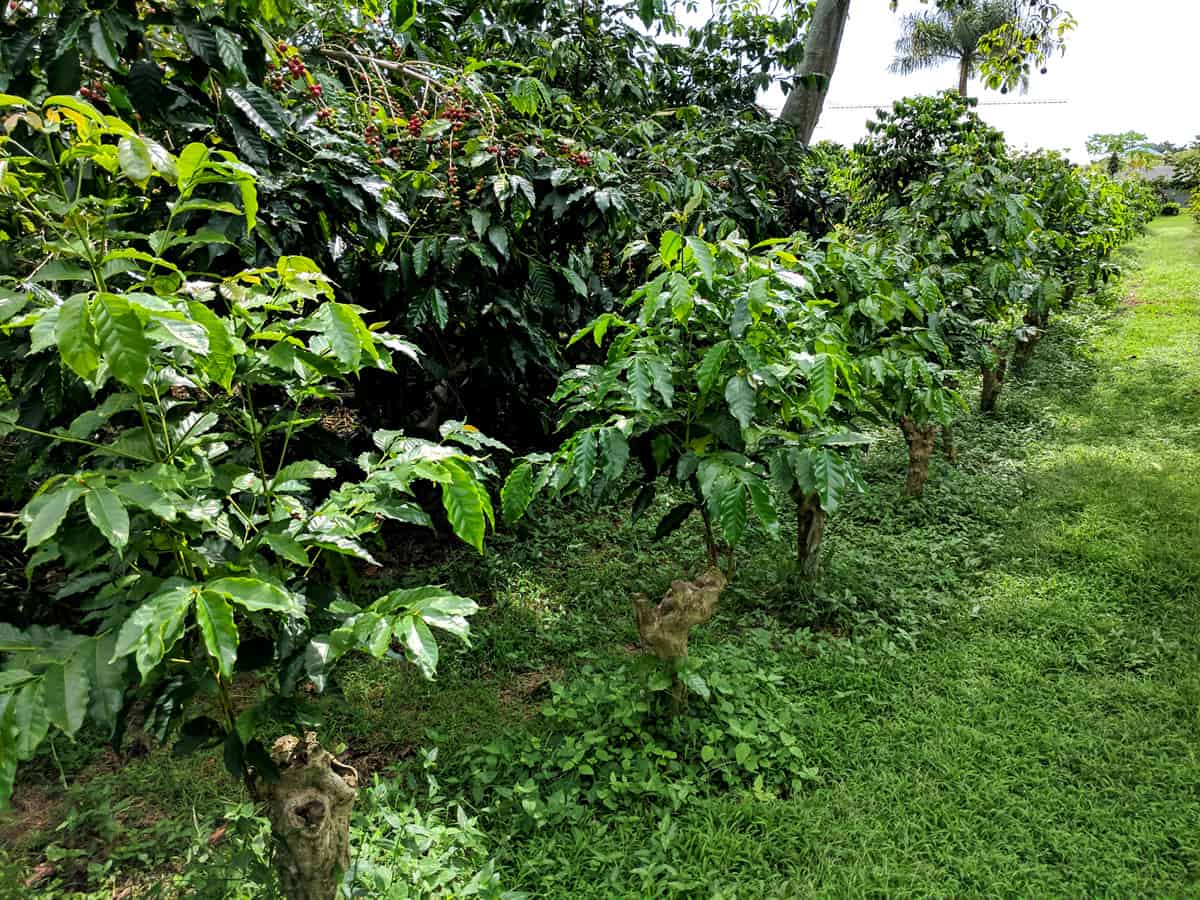
The Kauai Coffee Company plantation cultivates 3,100 acres of coffee plants and is located at a relatively low elevation on former sugarcane lands which are irrigated.
About 85% of the coffee plants at the Kauai Coffee Company plantation are of the coffee plant varietal Yellow Catuai from Brazilian seed. Also grown are the varietals Typica (Guatemalan seed), Red Catuai (Brazilian seed), Mundo Novo (Central American seed) and Blue Mountain (Jamaican seed).
Harvesting
The coffee cherry at the Kauai Coffee plantation are mechanically harvested much like the large-scale coffee growing operation on Molokai.
The flowers begin blossoming in February or March with fruit beginning to form by May and then ripening beginning about late September. Harvesting takes place from about the middle of October into early December.
Mechanical harvesting takes place 24 hours per day, seven days a week in three shifts. Kauai coffee uses twelve mechanical harvesters that were originally designed to harvest blueberries and have been modified to be more efficient for picking coffee cherry (coffee fruit).
Processing
Once the coffee cherry is harvested it is taken immediately to a wet processing plant where the fruits are sorted into three categories based on density and hardness: immature, natural and ripe.
Five grades of coffee are produced during processing. The processing plant at Kauai coffee handles an average daily capacity of about 650,000 pounds of coffee cherry.
During pulping the coffee fruits' skin and fleshy fruit are removed by a pulper, and then hydro-washed to remove the sticky mucilage coating the coffee beans.
Drying
Next the coffee beans go through pre-dryers where they are exposed to a fluidized bed of air which begins the coffee drying process which is completed by placing the coffee beans in heated drying elevators for 18 to 36 hours.
During the drying the heat may be turned off for eight hours or more to simulate the traditional patio drying methods that expose coffee beans to cool nighttime breezes. When the drying is completed the remaining product is known as parchment, or pergamino and the moisture content of the coffee beans ranges from eleven to twelve percent.
Milling and sorting
The next step in the Kauai Coffee Company processing is to mill the coffee beans and remove the parchment as well as the silverskin. The beans are sorted using sizing screens and density tables.
An electronic eye is used to scan the color of each bean and isolate the finest colored beans. A blast of air removes the lesser quality beans. About 5% of each crop is selected as Estate Reserve.
Roasting and packaging
At this point every batch of coffee beans is graded as well as "cupped" to taste its flavor. An inspector from the State of Hawaii Department of Agriculture then provides a certification of the coffee's grade quality as well as its origin.
The final step is the roasting and packaging of the coffee and then shipping to many locations in the Hawaiian Islands as well as all over the world. Among Kauai Coffee's products is a decaffeinated coffee that uses the Swiss Water Process of Decaffeination.
Kauai Coffee Company
The largest coffee plantation in the Hawaiian Islands as well as the United States is run by the Kauai Coffee Company which cultivates 3,100 acres of coffee on the southwestern shore of the island of Kauai, which is the northernmost of the eight main Hawaiian Islands.
The McBryde Sugar Company was one of Hawaii's first sugarcane companies when it began operations in the early 1800s. The company transformed into the Kauai Coffee Company in 1987. The operation first began as a joint venture with Hills Brothers and later with the Nestle Beverage Company.
When Hurricane Iniki devastated Kauai in 1992 it also devastated the Kauai Coffee operation causing $8.5 million in damage to the coffee crop. By 1996 they were back on track with a harvest that exceeded the total output of the whole Kona Coffee region.
Today Kauai Coffee is thriving, and with its parent company Alexander and Baldwin (which was one of Hawaii's "Big Five" sugar companies) owns more than 22,000 acres on Kauai.
Most of the coffee plants at the Kauai Coffee Company plantation are of the varietal Yellow Catuai (Brazilian seed) which comprises about eighty-five percent of the acreage. The remainder of the land is planted with the varietals Typica (Guatemalan seed), Red Catuai (Brazilian seed), Mundo Novo (Central American seed) and Blue Mountain (Jamaican seed).
The coffee plants are grown in long, regular rows which are irrigated. Some say this is the largest irrigated coffee plantation in the world.
All of the coffee at the Kauai Coffee Company plantation is mechanically harvested, unlike Hawaii's premier coffee grown in Kona which is all hand picked. Coffee processing of the Kauai Coffee Company crop involves the wet processing method and utilizes aqua-pulpers to remove the coffee cherry's mucilage.
More coffee is grown at the Kauai Coffee Company plantation than in the whole Kona region. Harvesting of the coffee cherry begins around the middle of October and continues into December.
Tour
A self-guided tour of the Kauai plantation leads on a meandering path through a section of coffee plants with informational signs that help you learn about the coffee growing, the history of the plantation.
Interpretive signs provide identify coffee plant varietals and the stages of the coffee season from the flowering to the coffee harvest and the stages of processing as well as roasting.
The Kauai Coffee Company Visitor Center is open daily and provides free coffee tastings of the different coffee varietals being grown on the plantation.
The Visitor Center also has a snack shop that offers home-baked pastries and ice cream. A gift shop sells souvenirs, specialty foods, and of course Kauai Coffee products.
For more information see: Hawaii Coffee; Big Island Coffee; Kona Coffee; Oahu Coffee; Maui Coffee; Molokai Coffee;
Hawaii Coffee and Espresso Brewing Tips
For tips on brewing the perfect cup of Hawaii coffee see our section titled All About Coffee including tips on Coffee Brewing. You can also read detailed coffee flavor profiles of Gourmet Coffees and instructions on preparing the finest Espresso Drink Recipes.
Leave a Reply